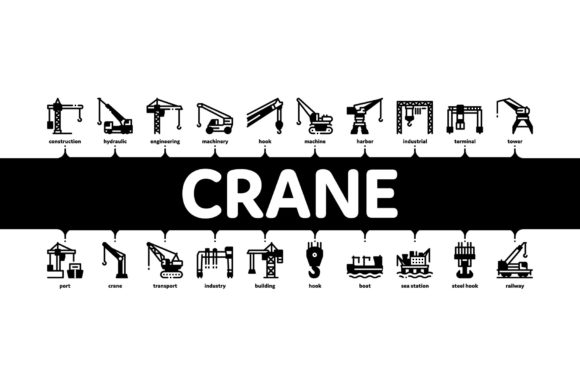
Crane Building Machine Minimal: Streamlining Visuals for Construction and Logistics
When you are designing a presentation, website, or marketing collateral for the heavy industry sector, finding imagery that balances technical accuracy with modern aesthetic standards can be surprisingly difficult. The Crane Building Machine Minimal design style addresses this specific gap by stripping away visual noise to focus on function, form, and clarity. Rather than relying on hyper-realistic photography that can sometimes look cluttered or dated, minimal vector illustrations of tower cranes, port machinery, and lifting equipment offer a clean, professional alternative that communicates efficiency and precision.
This design approach is not merely an artistic choice; it is a practical solution for professionals who need to convey complex industrial concepts quickly. Whether depicting a crane port construction scene for unloading ships or a tower crane erecting a residential high-rise, the minimal style ensures the viewer understands the action immediately. By utilizing formats like EPS and JPG, these assets bridge the gap between scalable print materials and optimized web graphics, making them versatile tools for architects, logistics managers, and digital marketers alike.
Elevating Corporate Presentations and Stakeholder Reports
One of the most immediate applications for minimal crane illustrations is in corporate communications. When presenting quarterly results, safety protocols, or project timelines to stakeholders, dense text and chaotic site photos can cause cognitive overload. A Crane Building Machine Minimal infographic serves as a visual anchor that breaks up content while reinforcing key messages.
Consider a logistics company reporting on port throughput efficiency. Instead of using a grainy photo of a busy dock, a clean vector illustration of a gantry crane unloading containers allows the presenter to overlay data points directly onto the image. The negative space inherent in minimal design provides room for annotations, statistics, and flow arrows without obscuring the machinery itself. This is particularly useful when explaining new operational workflows where the specific brand or color of the physical crane is irrelevant, but the mechanical process is critical. The result is a slide deck that looks cohesive and intentional, rather than a scrapbook of disparate stock photos.
Architectural Visualization and Urban Planning
For architects and urban planners, the context of construction equipment matters as much as the building itself. During the proposal phase, clients often struggle to visualize how a construction site will integrate into an existing cityscape. Hyper-realistic renders of cranes can sometimes appear imposing or industrial in a way that alarms community members. Minimal illustrations soften this impact.
A stylized tower crane lifting weight against a simplified skyline suggests progress without emphasizing the grit of demolition or excavation. This aesthetic is invaluable for public consultation documents and environmental impact assessments where the goal is to demonstrate activity levels and scale without triggering negative associations with noise or dust. Furthermore, because these vectors are editable in EPS format, designers can adjust the height of the tower or the angle of the jib to match specific site plans, ensuring the visualization remains accurate to the engineering constraints while maintaining a polished, approachable appearance.
Enhancing Digital User Experience in Industrial Sectors
Websites serving the construction and maritime industries often suffer from slow load times due to high-resolution imagery. Here, the Crane Building Machine Minimal web banner vector becomes a performance asset. Vectors are mathematically defined, meaning they render crisply on 4K monitors and mobile devices alike while maintaining a tiny file size compared to raster images.
Beyond performance, these illustrations guide user navigation. On a heavy equipment rental platform, distinct minimal icons can differentiate between hydraulic cranes, tower cranes, and floating cranes more effectively than generic thumbnails. Users scanning a catalog can identify the specific type of machinery they need in milliseconds. This functional iconography reduces friction in the user journey, leading to higher engagement and lower bounce rates. For educational platforms teaching crane operation or rigging safety, minimal diagrams remove background distractions, allowing students to focus entirely on load paths, center of gravity, and mechanical linkages.
Safety Training and Operational Manuals
Clarity is a safety requirement. In training materials for crane operators and ground crews, realistic photos can sometimes hide critical details in shadows or complex backgrounds. Minimal line art and flat-color illustrations highlight exactly what needs to be seen. When illustrating proper rigging techniques or signaling protocols, a Crane Building Machine Minimal style ensures that hand signals, sling angles, and load positioning are unmistakable.
This is especially relevant for multilingual workforces. Simplified visuals transcend language barriers more effectively than detailed photographs. A universal visual language based on geometric shapes and clear lines helps standardize safety understanding across diverse teams. Additionally, when updating manuals for new regulations, editing a vector file is significantly faster and cheaper than organizing a new photoshoot on an active job site. Safety officers can modify warning zones or update equipment depictions internally without waiting for external vendors.
Practical Considerations for Format Selection and Implementation
While the aesthetic benefits are clear, choosing between JPG and EPS formats requires understanding your end-use case. Both formats have distinct strengths that dictate their application in professional workflows.
- EPS (Encapsulated PostScript): This is your master source file. It is essential for print media such as billboards, trade show banners, and vehicle wraps. Because it is vector-based, you can scale a crane illustration from the size of a business card to the side of a shipping container without any loss of quality. It also allows for color manipulation; if your client’s branding shifts from blue to green, you can recolor the entire crane fleet in seconds within Adobe Illustrator or similar software.
- JPG (Joint Photographic Experts Group): Use this for final delivery in digital environments where editing is not required. While JPGs are raster images and will pixelate if enlarged too much, they offer smaller file sizes and universal compatibility. They are ideal for email newsletters, social media posts, and web headers where fast loading is prioritized over infinite scalability.
A common pitfall is treating all minimal designs as interchangeable. However, the level of abstraction should match the audience's expertise. Engineers may require a minimal style that still accurately depicts counterweights, trolley systems, and slewing units. Marketing materials aimed at investors might prefer a more symbolic representation that conveys "lifting" and "growth" without mechanical specificity. Always verify that the chosen asset aligns with the technical literacy of the viewer.
Navigating Licensing and Customization
When integrating these assets into commercial projects, licensing is a practical concern. Stock vectors of crane port construction or tower cranes are widely available, but exclusivity varies. If you are creating a unique brand identity for a construction firm, relying on a popular free vector might result in visual overlap with competitors. Investing in premium or exclusive licenses ensures your visual identity remains distinct.
Customization extends beyond color. The modularity of vector files allows you to combine elements from different sources. You might take the tower section from one Crane Building Machine Minimal asset and the jib from another to create a hybrid machine that matches a specific manufacturer’s model. This flexibility is crucial for equipment dealers who need to showcase inventory that doesn't perfectly match generic stock art. However, always ensure that modifications do not misrepresent safety features or operational capabilities, as accuracy in industrial illustration carries ethical and legal weight.
The Strategic Value of Visual Simplicity
Ultimately, adopting a minimal aesthetic for crane and construction imagery is a strategic decision about communication efficiency. In an industry defined by complexity, risk, and massive scale, simplicity acts as a filter that clarifies intent. Whether used to streamline a web banner, clarify a safety protocol, or beautify an architectural proposal, these illustrations perform heavy lifting in the design sense.
By leveraging both JPG and EPS formats appropriately, professionals can maintain a consistent visual thread across print and digital touchpoints. The result is a brand presence that feels organized, modern, and competent—qualities that directly mirror the values of the construction and logistics industries themselves. When the visual noise is removed, the message of capability and reliability stands out with greater force, proving that in industrial design, less often communicates more.