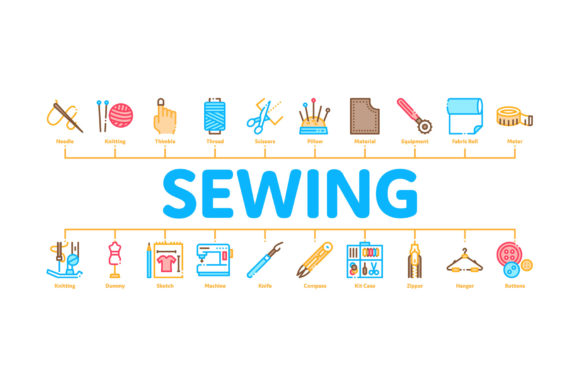
Evaluating Sewing and Needlework Minimal Vector Assets for Professional Design
In the competitive landscape of digital content creation, visual clarity often determines user engagement. For professionals in the textile, fashion, and craft education sectors, finding imagery that balances aesthetic appeal with functional communication is a persistent challenge. The Sewing and Needlework Minimal vector collection addresses this specific need by offering a streamlined, infographic-ready approach to traditional craft iconography. Rather than relying on ornate or overly complex illustrations, this asset pack focuses on essential symbols—needles, measuring tapes, dress forms, bobbins, buttons, and fabric swatches—rendered in a clean, minimalist style. This evaluation examines the practical utility, technical quality, and strategic application of these resources for marketers, educators, and small business owners.
Defining the Minimalist Aesthetic in Craft Imagery
The term "minimal" in the context of sewing and needlework graphics does not imply a lack of detail, but rather a deliberate reduction of visual noise. Traditional sewing illustrations often feature heavy shading, realistic textures, and cluttered compositions that can distract from the core message when scaled down for web banners or mobile interfaces. The Sewing and Needlework Minimal series diverges from this convention by utilizing flat design principles, consistent stroke weights, and negative space to create immediate recognition.
This stylistic choice serves a functional purpose. When designing an infographic explaining garment construction steps or a blog header for a quilting tutorial, the viewer’s cognitive load must be managed effectively. Simplified icons allow the audience to process information faster. The inclusion of specific elements like the dummy (dress form) and bobbin provides contextual anchors without overwhelming the layout. For creators targeting an adult demographic aged 20–50, this mature, uncluttered aesthetic signals professionalism and modernity, distinguishing serious educational content from juvenile craft projects.
Technical Versatility: EPS and JPG Formats
A critical factor in evaluating any digital design asset is file format flexibility. This collection provides both EPS and JPG files, each serving distinct roles in a professional workflow. Understanding when to utilize each format is essential for maximizing the value of the Sewing and Needlework Minimal package.
- EPS (Encapsulated PostScript): This is the primary working file for designers. As a vector format, it allows for infinite scaling without pixelation. Whether you are creating a small social media icon or a large-format trade show banner, the lines remain crisp. Crucially, EPS files enable color customization. If your brand guidelines dictate a specific Pantone shade of teal, you can modify the vector paths directly in Adobe Illustrator or Affinity Designer to match. This editability ensures long-term usability across rebrands and seasonal campaigns.
- JPG (Joint Photographic Experts Group): While raster-based, the included JPGs offer immediate utility for non-designers or rapid prototyping. They are pre-rendered at high resolution, making them suitable for direct insertion into Word documents, PowerPoint presentations, or CMS platforms that do not support vector uploads. However, users should note that JPGs lack transparency and cannot be resized upward without quality loss. They serve best as reference points or final outputs for web use where file size is a concern.
Practical Applications in Digital Marketing and Education
The true measure of these assets lies in their real-world performance. Based on current design trends and user intent analysis, the Sewing and Needlework Minimal illustrations excel in several specific scenarios.
Web Banners and Hero Images
For sewing pattern retailers or fabric shops, website headers must communicate niche relevance instantly. The concept illustrations featuring fabric colors and needles provide excellent compositional balance. Because the designs are minimal, they leave ample negative space for overlaying typography. This is a significant advantage over photographic stock images, where text placement is often difficult due to busy backgrounds. Marketers can position headlines clearly against the solid or simple gradient backgrounds typical of this vector style, improving both readability and SEO accessibility through proper alt-text association.
Instructional Infographics
Educators and content creators producing "how-to" guides benefit significantly from the standardized visual language of this set. Consistency is key in instructional design; mixing disparate illustration styles confuses learners. By using a unified set containing bobbins, measures, and dummies, creators can build multi-step diagrams that feel cohesive. The clear depiction of tools helps bridge language barriers, making tutorials more accessible to international audiences who may rely on visual cues over written instructions.
Product Packaging and Branding
Small business owners selling handmade goods or sewing supplies often require custom packaging on a budget. The scalable nature of the EPS files allows these minimal illustrations to be adapted for hang tags, stickers, or box prints. The sophisticated, understated look elevates perceived product value, aligning well with the contemporary maker movement's preference for artisanal yet polished branding.
Assessing Quality and Usability Limitations
While the Sewing and Needlework Minimal collection offers substantial value, objective evaluation requires acknowledging potential limitations. No single asset pack solves every design problem, and understanding constraints prevents frustration during production.
Stylistic Rigidity: Minimalism relies on geometric simplification. If your project requires hyper-realistic depictions of fabric weave or intricate lace patterns, this vector set will be insufficient. It represents the concept of sewing rather than the tactile reality. Users needing photorealism should supplement these vectors with photography rather than expecting the vectors to perform double duty.
Color Customization Requirements: While the ability to recolor EPS files is a strength, it also demands proficiency with vector editing software. Users without access to or experience with such tools are limited to the pre-set color palettes of the JPG versions. Before purchasing, verify that your current software stack supports EPS editing if customization is a priority.
Contextual Specificity: The general nature of "sewing and needlework" icons means they may lack specificity for highly specialized niches. A serger, embroidery hoop, or knitting needle might not be represented if the set focuses strictly on basic sewing concepts like buttons and bobbins. Review the exact manifest of included elements to ensure alignment with your specific sub-niche before integration.
Strategic Value for Target Audiences
Different stakeholders derive varying levels of ROI from this type of creative asset. Identifying where the Sewing and Needlework Minimal collection fits within your specific operational context helps justify the investment.
Freelance Designers and Agencies: For professionals managing multiple client accounts in the lifestyle and craft sector, this pack serves as a reliable foundational library. It reduces billable hours spent drawing basic icons from scratch, allowing more time for high-level strategy and custom illustration. The commercial licensing typically associated with such vector packs (always verify specific license terms) enables safe deployment across client projects.
Bloggers and Content Publishers: Site speed and visual consistency directly impact bounce rates and ad revenue. Lightweight vector-derived graphics load faster than high-resolution photographs. Furthermore, the professional tone of minimal illustrations supports monetization efforts by attracting premium advertisers who prefer brand-safe, polished environments over amateurish aesthetics.
Educators and Course Creators: In e-learning, visual assets are pedagogical tools. The clarity of these illustrations aids knowledge retention. Investing in high-quality, consistent visuals reduces student support queries caused by confusing diagrams, ultimately protecting the reputation of the educational program.
Making the Final Determination
The decision to incorporate Sewing and Needlework Minimal assets should be driven by project requirements rather than trend adherence. If your goal is to establish a modern, accessible, and scalable visual identity for sewing-related content, this collection provides a robust technical and aesthetic foundation. The dual-format delivery accommodates both expert designers and novice users, while the focused subject matter ensures relevance without excess.
However, success depends on appropriate application. These assets function best as part of a broader design system rather than standalone solutions. Pair them with thoughtful typography, adequate whitespace, and complementary photography to create comprehensive visual narratives. Evaluate your current asset library for gaps in consistency or quality; if existing sewing graphics appear dated, mismatched, or technically inadequate, this minimal vector set represents a practical upgrade path. Ultimately, the value lies not merely in owning the files, but in leveraging their clean, functional design to communicate more effectively with an audience that values both craftsmanship and clarity.