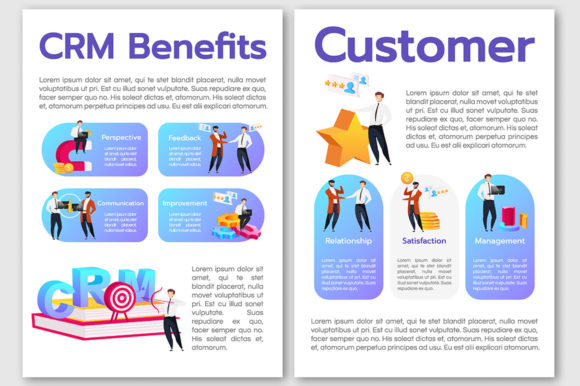
CRM Benefits Flat Vector Brochure: Visualizing Business Value with Clarity
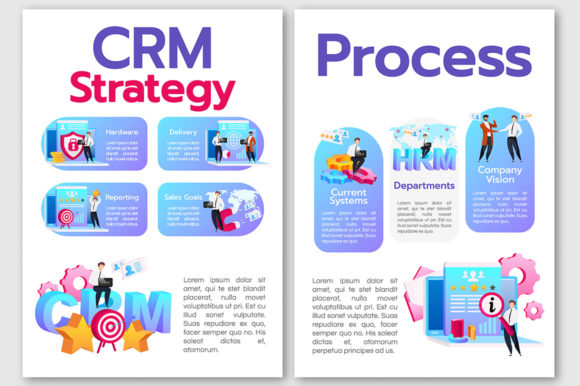
Communicating the value of complex software solutions requires more than just technical specifications; it demands visual storytelling that resonates with decision-makers. A CRM Benefits Flat Vector Brochure serves as a specialized design asset aimed at bridging the gap between intricate customer relationship management data and clear, actionable business insights. For marketing teams, sales directors, and corporate communicators, this resource is not merely a graphic template but a strategic tool for translating abstract software capabilities into tangible organizational advantages. By utilizing flat vector aesthetics, businesses can present modern, clean, and scalable visuals that maintain integrity across every medium, from high-resolution magazine pages to compact printable leaflets.
The Challenge of Communicating Software Value
One of the most persistent hurdles in B2B marketing is simplifying technical benefits without diluting their importance. Customer Relationship Management systems are multifaceted ecosystems involving automation, analytics, pipeline management, and customer service integration. When stakeholders review annual reports or training booklets, they often face dense text and outdated stock photography that fails to capture the dynamic nature of these tools. This disconnect can lead to low adoption rates among staff or hesitation from investors who cannot visualize the return on investment.
The need for a dedicated CRM Benefits Flat Vector Brochure arises from this specific friction point. Traditional raster images pixelate when resized for large-format infographic posters, while generic illustrations lack the specific iconography needed to represent CRM functions like lead scoring or churn reduction. Organizations require a versatile design foundation that allows for rapid customization while maintaining brand consistency. Whether the goal is internal communication during a software rollout or external promotion in a trade show flyer, the visual language must be professional, approachable, and instantly understandable.
How Flat Vector Design Enhances Comprehension
Flat design has become the industry standard for tech communication because it prioritizes function over ornamentation. A CRM Benefits Flat Vector Brochure leverages this style to reduce cognitive load. By removing unnecessary shadows, gradients, and textures, the viewer’s attention remains fixed on the message rather than the decoration. This minimalist approach is particularly effective when explaining multi-step processes or hierarchical data structures common in CRM platforms.
The vector format ensures that these brochures remain crisp regardless of the output size. A designer can take a single master file and adapt it for a pocket-sized booklet or a massive convention banner without losing quality. This scalability is essential for omnichannel campaigns where the same visual assets must perform across digital screens and physical print media. Furthermore, flat vectors are inherently friendly and accessible, softening the perceived complexity of enterprise software and making the content feel more inviting to non-technical users.
Practical Applications Across Media Formats
The versatility of a comprehensive brochure template extends far beyond a standard tri-fold layout. When organizations implement these assets, they unlock a suite of communication possibilities tailored to different audiences and contexts.
- Printable Leaflets and Flyers: For sales teams attending conferences or visiting clients, a concise leaflet highlighting top-tier CRM benefits provides a tangible takeaway. The flat vector style ensures that even small text areas remain legible and that colors print accurately on various paper stocks.
- Magazine Pages and Editorials: Industry publications often require high-quality visuals to accompany thought leadership articles. These templates provide structured layouts with ample text space, allowing editors to integrate CRM success stories seamlessly into editorial spreads without custom illustration costs.
- Cartoon Annual Reports: Modern corporate reporting is shifting away from dry tables toward narrative-driven visuals. Using cartoon-style flat vectors in annual reports helps humanize data, illustrating how CRM improvements translated to better customer experiences and employee satisfaction in a way that engages shareholders.
- Infographic Posters: Training rooms and office hallways benefit from large-format posters that reinforce key workflows. A CRM Benefits Flat Vector Brochure template can be expanded into an educational poster that maps out user journeys or feature benefits, serving as a constant visual reference for staff.
Navigating File Formats for Maximum Utility
To fully leverage these design resources, users must understand the practical implications of the included file formats. A robust CRM Benefits Flat Vector Brochure package typically includes EPS, AI, SVG, JPG, and PNG files, each serving a distinct purpose in the production workflow.
AI and EPS Files: These are the source files intended for professional designers using Adobe Illustrator or similar vector software. They allow for complete manipulation of colors, shapes, and text. If your organization needs to rebrand the brochure to match new corporate guidelines or update specific CRM feature names, these editable vectors are indispensable. They preserve the mathematical precision of the artwork, ensuring infinite scalability.
SVG Files: Scalable Vector Graphics are crucial for web implementation. Unlike raster images, SVGs render perfectly on retina displays and mobile devices while maintaining tiny file sizes. Marketing teams can embed these directly into landing pages, email newsletters, or interactive PDFs to ensure the CRM benefits look sharp on any screen.
JPG and PNG Files: These rasterized versions serve as immediate-use assets for non-designers. A social media manager might use the PNG (with transparency support) to overlay CRM icons onto a photo background, while a sales representative could insert a high-resolution JPG into a PowerPoint presentation. Having these pre-rendered options accelerates turnaround times for urgent communications where opening vector software is not feasible.
Tailoring the Approach for Different Stakeholders
While the design asset is universal, its application should vary based on the target audience. Understanding these nuances ensures the CRM Benefits Flat Vector Brochure delivers maximum impact.
For Internal Change Management
When introducing a new CRM to employees, the focus should be on personal benefit and ease of use. Utilize the cartoon or character-based elements within the template to create relatable scenarios. Instead of listing "automated data entry" as a feature, illustrate a character leaving work on time because manual tasks were eliminated. Booklets designed for onboarding should prioritize step-by-step visual guides over marketing fluff, using the template’s modular layout to break down complex features into digestible chunks.
For External Sales and Marketing
External communications require a polish that conveys competence and reliability. Here, the flat vector aesthetic should lean towards geometric precision and brand-aligned color palettes. Flyers and magazine ads should emphasize outcomes like revenue growth, retention rates, and ROI. Use the provided text space to pair compelling statistics with corresponding icons. The goal is to create a visual rhythm that guides the prospect’s eye from the problem to the CRM solution effortlessly.
For Executive Reporting
C-suite executives and board members need high-level summaries. In this context, the brochure template functions as a framework for executive summaries within larger documents. Use the infographic components to visualize year-over-year comparisons or departmental performance metrics. The clean lines of flat vector art convey professionalism and clarity, avoiding the clutter that often plagues data-heavy presentations.
Implementation Recommendations and Best Practices
To get the most out of a CRM Benefits Flat Vector Brochure template, consider the following strategic recommendations during implementation:
- Maintain Visual Hierarchy: Do not fill every available text space. White space is a critical component of flat design that aids readability. Prioritize the three to five most critical CRM benefits rather than overwhelming the reader with an exhaustive feature list.
- Ensure Brand Consistency: Before deploying any modified assets, audit them against your current brand style guide. Adjust the vector colors and typography in the AI/EPS files first, then export updated JPG/PNG versions. Inconsistent branding undermines the professional credibility of the material.
- Contextualize the Imagery: Generic vectors are a starting point, not a finish line. Customize the illustrations to reflect your actual CRM interface or specific industry terminology. If your CRM uses specific terms like "Opportunities" instead of "Deals," update the accompanying icons and labels to match your users' reality.
- Test Across Mediums: Always proof designs in their final format. Colors that look vibrant on an RGB screen may appear dull in CMYK print. Text that is readable in a digital PDF may be too small in a printed leaflet. Utilize the appropriate file type for each medium to avoid costly reprinting or poor user experience.
Ultimately, a CRM Benefits Flat Vector Brochure is more than a collection of graphics; it is a communication accelerator. By providing a structured, scalable, and aesthetically pleasing foundation, it empowers organizations to articulate the value of their technology investments with confidence. Whether used for a detailed booklet, a quick-reference flyer, or a comprehensive annual report, these templates enable teams to move past the struggle of creation and focus on the strategy of connection. In an era where attention is scarce and clarity is currency, leveraging professional vector resources is a practical step toward more effective business communication.