Strategic Application of Google Slides Template - Stacy for Professional Communication
Selecting the right presentation framework is a strategic decision that directly influences how stakeholders perceive your message, brand authority, and operational maturity. The Google Slides Template - Stacy serves as more than a mere aesthetic container; it functions as a structured communication system designed to streamline the creation of high-impact decks across diverse professional contexts. Whether you are preparing a pitch deck for investors, refining a company profile for potential clients, or organizing a personal portfolio, this template provides a foundational architecture that balances visual appeal with functional clarity. Understanding its specific utility requires moving beyond surface-level design appreciation to evaluate how its features support tangible business outcomes and long-term communication goals.
Aligning Visual Structure with Business Objectives
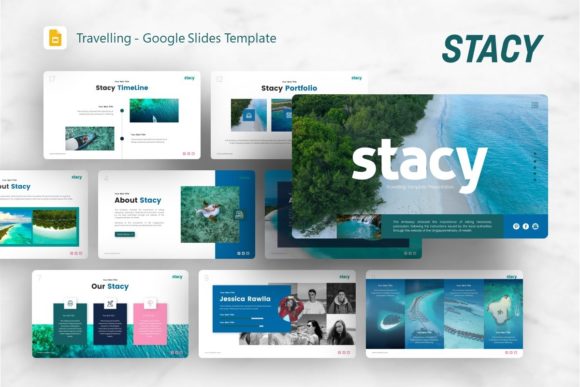
The primary value of the Introducing Stacy Travelling Presentation lies in its versatility without sacrificing coherence. For entrepreneurs and marketers, the challenge often involves adapting a core narrative for different audiences while maintaining brand consistency. This template addresses that friction point by offering 36 distinct slides tailored for varied purposes, including creative agency showcases, corporate reporting, and startup fundraising. However, having access to numerous slides is only advantageous if they are deployed with intention. Strategic use involves auditing your current communication gaps and selecting specific layouts from the Stacy template that bridge those gaps rather than simply filling time slots.
For example, a startup founder preparing for a Series A meeting should not utilize every available slide. Instead, they should leverage the template’s handcrafted infographics to visualize market traction and the pixel-perfect illustrations to explain complex product ecosystems. Conversely, a freelancer building a personal portfolio might focus on the picture placeholders and minimalist typography to let their work take precedence over decorative elements. The template becomes a strategic asset when users map specific slide types to distinct phases of their customer journey or stakeholder engagement process.
Operational Efficiency Through Master Slide Architecture
Productivity in presentation design is frequently misunderstood as speed at the expense of quality. True operational efficiency comes from systems that reduce repetitive labor while ensuring consistency. The Google Slides Template - Stacy is built upon Master Slides, a feature that allows for global, non-destructive changes across multiple layouts. For small business owners and educators managing frequent updates, this architecture is critical. It enables teams to update logos, color palettes, or footer information in one location, instantly propagating those changes throughout the entire deck. This reduces version control errors and ensures that every external-facing document adheres to current branding guidelines.
Beyond simple formatting, the inclusion of fully resizable and editable graphics transforms the template into a dynamic resource. Teams often waste hours recreating charts or searching for compatible icons. Because all graphics in this template are vector-based and integrated directly into the file structure, they can be modified to reflect real-time data without requiring external design software. This capability supports agile decision-making, allowing presenters to adjust visuals minutes before a meeting based on new insights or audience feedback. The documentation file included with the download further accelerates adoption, reducing the learning curve and enabling team members with varying design skills to produce professional-grade outputs independently.
Enhancing Narrative Clarity with Purpose-Built Infographics
Data visualization is a common failure point in professional presentations. Complex information presented as dense text or generic bar charts often leads to cognitive overload and disengagement. The handcrafted infographics within the Google Slides Template - Stacy offer a solution grounded in information design principles. These are not stock assets but purpose-built visual metaphors designed to clarify relationships, processes, and hierarchies. When used correctly, they serve as cognitive anchors that help audiences retain key messages.
To maximize this feature, practitioners must first distill their data into a clear insight before selecting a graphic. If the goal is to show growth over time, choose a timeline or ascending chart variant. If the objective is to compare competitive advantages, utilize the matrix or comparison layouts provided. Avoid using intricate infographics simply because they look impressive; every visual element must earn its place by reducing ambiguity. The pixel-perfect nature of these illustrations ensures they remain crisp on any display, from mobile devices during remote calls to large-format screens in conference rooms, preserving the integrity of your message regardless of the delivery medium.
Risk Mitigation and Contextual Awareness
While templates accelerate production, relying on them without contextual awareness introduces significant risks. The most common pitfall is the "template trap," where the structure dictates the content rather than supporting it. Users may feel compelled to include sections simply because they exist in the Google Slides Template - Stacy, resulting in bloated decks that dilute the core message. Before opening the file, define your single overriding communication objective. If a specific slide layout does not advance that objective, delete it. Ruthless editing is a hallmark of professional communication.
Another risk involves licensing and asset management. It is vital to note that all images in the demo are for preview purposes only and are not included in the downloadable files. Failing to account for this can lead to last-minute scrambles for suitable imagery or, worse, copyright infringement if placeholder images are accidentally retained. Establish a workflow for sourcing high-quality, licensed photography that complements the template’s aesthetic before beginning the design phase. Additionally, ensure that the template’s tone aligns with your industry norms. While Stacy is versatile, a highly playful layout might undermine credibility in conservative sectors like finance or legal services unless significantly adapted. Always test the modified template with a trusted colleague to gauge whether the visual language supports or distracts from your strategic intent.
Long-Term Value and Asset Scalability
Treating the Google Slides Template - Stacy as a disposable project file limits its return on investment. Forward-thinking professionals view it as a scalable design system. By customizing the master slides and saving a branded version, organizations can create a proprietary template library that evolves with their needs. This approach compounds value over time: each subsequent presentation requires less setup, maintains higher quality standards, and reinforces brand recognition through consistent visual cues.
Furthermore, the template’s compatibility with PowerPoint (.PPTX) ensures interoperability across different software environments. This is crucial for collaborative teams where stakeholders may use different platforms. The ability to share editable files without formatting loss facilitates smoother review cycles and co-creation sessions. For freelancers and agencies, this flexibility also means delivering client-ready assets that remain editable post-handoff, enhancing the perceived value of your service. Ultimately, the strategic advantage of this template emerges not from its initial download but from its integration into a disciplined, repeatable communication workflow that prioritizes clarity, efficiency, and audience alignment.
Practical Implementation Guidelines
To transition from ownership to mastery, consider the following implementation steps when deploying the Google Slides Template - Stacy:
- Audit Existing Assets: Before starting, gather all necessary copy, data points, and licensed imagery. Having content ready prevents design-led decisions that compromise narrative integrity.
- Customize Masters First: Adjust fonts, colors, and logo placement in the Master Slide view immediately. This establishes guardrails and prevents inconsistent manual edits later.
- Map Content to Layouts: Create a rough outline matching your key messages to specific slide numbers. Identify gaps where existing layouts need modification or where new custom slides are required.
- Leverage Vector Icons: Use the included vector icon set to create visual consistency. Avoid mixing these with raster icons from other sources, as style mismatches degrade professionalism.
- Test Across Devices: Preview the final deck on the actual hardware you will use for presentation. Verify that animations, transitions, and embedded media function correctly in the target environment.
- Document Modifications: If working in a team, maintain a brief style guide noting any deviations from the original template. This ensures future users understand the rationale behind customizations.
By approaching the Google Slides Template - Stacy with this level of strategic discipline, users transform a generic design tool into a specialized instrument for achieving business objectives. The result is not just a better-looking presentation, but a more effective communication process that drives clearer understanding, stronger engagement, and measurable outcomes. Success depends less on the template itself and more on the thoughtful intentionality brought to its application.